Thursday, May 25, 2006
 Saint Cecilia - A rather fanciful tale of Cecilia, her husband and brother in law tells that she was betrothed to an angel and remained a virgin. She was martyred after the men had died for their faith. Failing to suffocate her, three attempts were made to decapitate her. This also failed; she lingered for several days while making arrangements for her house to become a meeting place for Christians and providing for the poor. It was said that at her marriage she heard only heavenly music. For this reason she is often depicted holding an organetto. She has become the patroness of church music in general. Today many church music organizations are known as Cecilian societies.
From Gwen Fleischer, one of our presenters of ACE on May 28, 2006.
ST. FRANCIS OF ASSISI
The window of St. Francis of Assisi is the large window in the music area to the left of the altar area. He is probably the best known of the saints. Every time we go to a nursery to buy plants, there are statues of him. Many people have him in their garden. He is the one with birds on this shoulder and animals at his feet.St. Francis is known as the patron saint of animals, merchants, Italy and the environoment and is the founder of the Franciscans. The term is related to the Latin word for "brothers".. He was born either in 1181 or 1182 with the name of Giovanni, but he was called Francesco, which means "French man" - possibly he was born there. Hewas born into a very wealthy family and so got a very good education. In his younger days he really was in the party scene. One day he came across a beggar and gave him money. After a pilgrimage to Rome, he heard a voice saying he was to rebuild the little church in which he was praying. He sold some of his father's things to get the money. His father was not pleased and he was disinherited..
He was known for going barefoot and tooks vows of chastity and poverty. He and his followers were known for being cheerful and always full of songs. There are several legends that sprang up after his death in 1226, that illustrate his love for nature and animals.. In one, he and his companions were walking down a road and he heard the birds in the trees. He stopped and preached to them. The birds surrounded him and not one flew away. Another time, a ferocious wolf was terrifying a town by eating people as well as animals. Francis went searching in the hills for the wolf. When he found him, he made the sign of the cross and comanded the wolf to come to him and told him to make peace with the town. .He wrote several well known poems - The Canticle of the Sun and also the Prayer of St. Francis which we sing quite often from our songbook.
My favorite story about St. Francis has to do with Christmas and the Nativity scene or creche. During the Christmas season of 1223, Francis wanted to make a memorial to "that Child born in Bethlehem". He set up a rude stable with a live ox and ass and a child lying on the straw. People crowded to Midnight Mass and heard him read the Gospel story and preach. This setting helped give the creches we set up their popularity.
ST. CECILIA
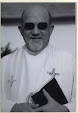
St. Cecilia is the large window in the side area to the right of the altar. She is the patron saint of music. Logically, the window would be on the music side. It was. The music side moved. Her feast was celebrated as early as the 4th century. Sometimes her day is listed in August or November. She is buried in the Catacombs in a crypt next to the chapel of the popes. One picture in the chapel has her in the rich clothing of a patroness of Pope Paschal. The property of this part of the Catacombs actually belonged to her family. She was a virgin from a prominent family. Her father was a Roman senator. From early childhood she dedicated her life to God with a vow of chastity. However, her parents arranged a marriage between her and a young noble named Valerian. It is not clear when she broke the news to Valerian that she had a vow of chastity. Some sources say before the wedding and some say after she had taken the vows of marriage. At any rate, she announced to Valerian she was betrothed to an angel and therefore would remain a virgin even though she was married. Surprisingly, Valerian agreed to this arrangement. Later he and his brother converted to Christiantiy. This was when it was illegal in Rome. They were martyred. Soon after Cecilia too was martyred. She was first locked in a bath inher home to be suffocated by the steam. She emerged unharmed. She was then beheaded. Supposedly, her head did not completely severe from the stroke of the axe and so she lived for 3 days. During this time, the story goes, she gave her assets to the poor and her home to be used as a church. She actually did not become patron saint of music until the 15th century and only because of a mistranslation from the Latin of the prayer to remain a virgin. Be that as it may, she is considered one of the muses of poetic art. She is often in paintings. If you see a woman with a rapt attention playing an organ or singing, it is most likely St. Cecelia. Both Handel and Henry Purcell wrote works dedicated to her. Chaucer makes direct referend to her in the Second nun's Priest Tale. The children's choir at St. Cross of Hermosa Beach is named the St. Cecilia Choir. Our own Father Bob used to sing in it under the direction of Russell Wing. He has a picture in his robes with a great big bow under his chin.
# posted by Father Bob+ @ 8:29 PM